Closed-cell foam insulation
Closed-cell foam is the highest-performing material for basement rim joists and foundation walls - it insulates and seals air in a single application.
Learn moreServing Kennewick, WA and surrounding areas. (509) 206-9343
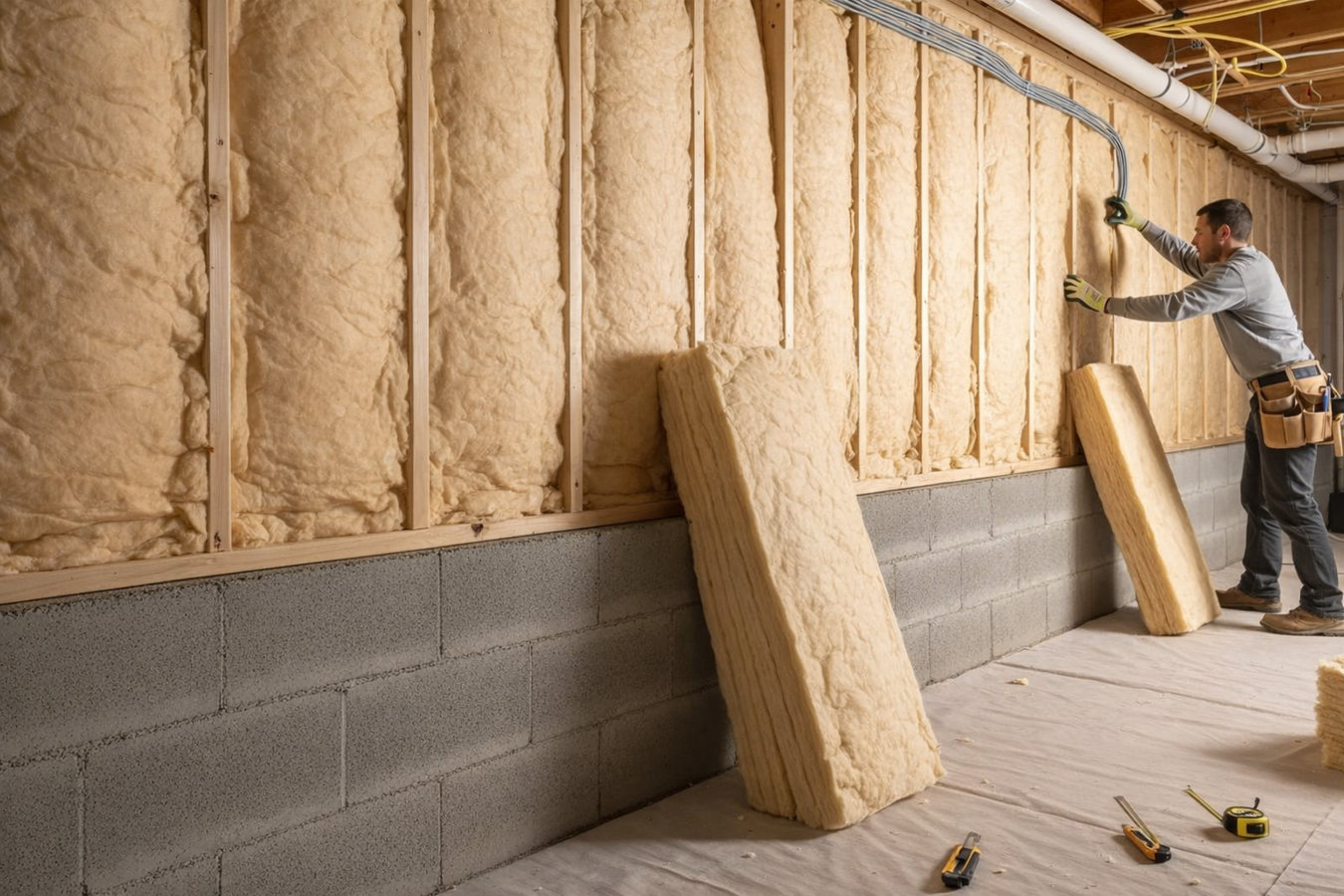
Cold floors and high winter heating bills are often a basement insulation problem. We insulate your foundation walls and rim joists so heat stays where you paid for it - inside your home.
Basement insulation in Kennewick creates a barrier that slows heat from escaping through your foundation walls and floor - most jobs on a standard unfinished basement are completed in one to two days. The work involves insulating the basement walls, the rim joist at the top of the foundation, or the ceiling between the basement and the floor above, depending on how you use the space and whether you heat it.
Kennewick homes built before 1990 often have little or no basement insulation, or original material that has compressed and degraded over decades. That missing layer is one of the most direct causes of cold kitchen floors in January and heating bills that climb every winter. The U.S. Department of Energy estimates that properly insulating and air-sealing a basement can reduce heating and cooling costs by 10 to 20 percent annually.
Basement insulation is often paired with closed-cell foam insulation on the rim joist - a spot where foundation walls meet the floor framing and where a large share of a home's air leakage occurs. Sealing that zone and insulating it together is one of the most cost-effective improvements a Kennewick homeowner can make.
If your Pacific Power bill spikes sharply from November through February without any change in how you use your home, heat is escaping somewhere. The basement is one of the most common culprits in Kennewick homes built before 1990. Uninsulated or under-insulated foundation walls can account for a significant portion of your home's total heat loss.
Walk barefoot across your kitchen or living room floor on a cold January morning. If it feels significantly colder than the rest of the house, the basement ceiling below it is likely under-insulated. Kennewick winters are cold enough that this temperature difference becomes very noticeable - and it means your heating system is working harder than it should.
Even in Kennewick's dry climate, spring snowmelt and irrigation runoff can push moisture against foundation walls. If you notice a damp smell or faint staining on the lower portion of your basement walls after a wet spring, investigate before insulating. Insulating over a moisture problem traps it - addressing it first protects both the insulation and your home.
Insulation that has been compressed loses much of its ability to slow heat transfer. If the insulation in your basement looks flattened, sagging, or has pulled away from the wall, it is no longer doing its job. This is especially common in older Kennewick homes where the original insulation was never designed to last more than a couple of decades.
We insulate basement walls using rigid foam boards or spray foam - the right choice depends on your basement layout, moisture history, and budget. Rigid foam boards are cut to fit and fastened directly to the wall; spray foam is applied as a liquid that expands, hardens, and seals gaps in a single step. For most Kennewick homeowners who want the highest performance per inch of thickness, we recommend closed-cell foam insulation on rim joists and above-grade wall sections - it outperforms standard batts at the same thickness and adds a moisture barrier at the same time.
We also address the ceiling between your basement and the floor above when the basement is an unheated storage area. That approach keeps the basement outside your home's thermal zone and insulates the floor you walk on instead of the walls around it. For any project that qualifies, we review Pacific Power rebate eligibility and federal tax credit options through the ENERGY STAR program during the estimate - not after the invoice.
Best for finished or regularly used basements - brings the whole space inside your home's thermal envelope.
High-impact, lower-cost fix that seals the leakiest part of most older Kennewick foundations - often combined with wall insulation.
Right choice for unheated storage basements - insulates the floor above rather than the space below.
Best for basements with irregular layouts or moisture history - seals and insulates in a single application.
Kennewick sits in the high desert of Eastern Washington, where winter temperatures regularly drop into the low 20s Fahrenheit and summer highs push past 100 degrees. That extreme seasonal swing means your basement is fighting heat loss in winter and heat gain in summer. A well-insulated basement helps with both - keeping the floors above it warmer in January and cooler in July without leaning on your furnace or AC any harder. A large share of Kennewick's housing stock was built between the 1970s and the 1990s, when energy codes were far less demanding than they are today - which means most basements in older Kennewick neighborhoods have a real performance gap to close.
Unlike Western Washington, Kennewick's dry climate means chronic basement dampness from rain is less common here - but the Columbia Basin's irrigated farmland and the area's soils can push seasonal moisture against foundation walls in spring. Before any insulation goes in, we check for those conditions. Homeowners in Richland and Pasco deal with the same climate conditions and the same 1970s-through-1990s housing stock - we work across all three cities and understand what each type of home needs.
We respond within 1 business day. Let us know your basement's rough size, whether it is finished or unfinished, and any moisture history. No obligation and no pressure to decide on the spot.
We walk through your basement, check for moisture or air leaks, measure the space, and explain what we recommend and why. You get a written estimate before we ask you to commit to anything.
Clear a path to the work area and move anything stored against the basement walls. That prep usually takes less than an hour. We will tell you exactly what is needed before we arrive.
Most unfinished basements are done in one to two days. When the work is complete, we walk you through everything that was installed and flag anything else we noticed - like a foundation crack - even if it is outside our scope.
No commitment required. We will walk through your basement, explain your options, and give you a written quote - including any Pacific Power rebates you may qualify for.
(509) 206-9343We know which basement insulation projects qualify for Pacific Power's energy efficiency rebates in Kennewick and can walk you through the application process as part of your estimate. Many homeowners leave that money on the table simply because no one told them to ask.
With winters dropping below 20 degrees Fahrenheit and summers routinely hitting 100 degrees or more, Kennewick's climate demands real insulation - not the bare minimum. We spec and install to a standard that holds up under those conditions year after year.
When a permit is required for your project, we pull it before work begins - we do not skip that step to save time at your expense. Permitted, documented work protects you and keeps a clear record for a future home sale.
We check for any signs of ground moisture before a single panel goes up. In Kennewick, spring irrigation runoff can occasionally push against foundation walls - and insulating over even a minor moisture issue leads to bigger problems down the road. That check is not optional on our jobs.
Kennewick's climate does not forgive under-insulated basements - and neither does a Pacific Power bill in February. We combine local knowledge, correct material selection, and honest pricing to make sure the job actually solves the problem.
Closed-cell foam is the highest-performing material for basement rim joists and foundation walls - it insulates and seals air in a single application.
Learn moreIf your home has a crawl space instead of a full basement, proper insulation and sealing of that space solves the same cold-floor and heat-loss problems.
Learn moreKennewick winters are long - book your basement insulation estimate now and have the work done before the next hard freeze.