Air sealing services
Air sealing closes the gaps that let conditioned air escape around your insulation, making wall insulation perform closer to its full rated value.
Learn moreServing Kennewick, WA and surrounding areas. (509) 206-9343
Kennewick summers hit 105 degrees and winters bring hard freezes - but most homes built before the mid-1990s have walls that were never insulated to handle that range. We assess what is in your walls now, fill the gaps, and document the work so you can see the difference.
Wall insulation in Kennewick creates a thermal buffer inside your exterior walls, slowing heat from pushing in during summer and escaping during winter. Most finished-wall jobs take a single day - the crew drills small access holes from outside or inside, blows insulation into each cavity, and patches everything before they leave. The result is quieter rooms, more even temperatures, and lower monthly energy costs.
A significant portion of Kennewick's single-family homes were built between the 1970s and early 1990s - a period when wall insulation standards were far lower than today. Many of those homes have walls that are partially empty or contain original material that has compacted and lost most of its effectiveness. Pairing wall insulation with air sealing services closes the gaps that let conditioned air sneak around any insulation already present.
The U.S. Department of Energy recommends exterior walls in Kennewick's climate zone reach a higher R-value than walls in milder parts of Washington - because the temperature swing between summer and winter here is among the widest in the state.
If your electricity bill jumps sharply during Kennewick's peak summer months - even when you keep the thermostat at the same setting - your walls may not be blocking enough heat. In a climate where outdoor temperatures regularly hit 105 degrees, a well-insulated wall makes a measurable difference in how hard your air conditioner has to work.
If one bedroom bakes in summer while another stays comfortable, or a west-facing room feels like an oven by late afternoon, the walls in that area likely have little to no insulation. This is especially common in Kennewick homes built in the 1970s and 1980s, where insulation was often inconsistently applied.
Press your hand flat against an interior wall on a cold winter morning. If it feels noticeably cold to the touch, or if you feel a draft near electrical outlets on exterior walls, that is a strong sign the wall cavity behind it has little insulation. This is one of the easiest self-checks a homeowner can do without any tools.
Homes built in this era in Kennewick were constructed to standards significantly lower than what is recommended today. If you have never had an energy assessment or insulation upgrade, there is a reasonable chance your walls are either empty or have insulation that has settled and compacted over decades. This is worth checking proactively.
For finished walls on existing homes, blown-in loose-fill insulation is the standard approach - and the one we use most often in Kennewick's housing stock. Small access holes are drilled in a grid pattern on the exterior or interior, insulation is blown into each wall cavity under controlled pressure, and the holes are patched and finished before we leave. The result is a fully filled wall cavity without tearing out any drywall. We pair this work with air sealing services to close gaps around outlets, pipes, and window frames that reduce the insulation's effectiveness when left open.
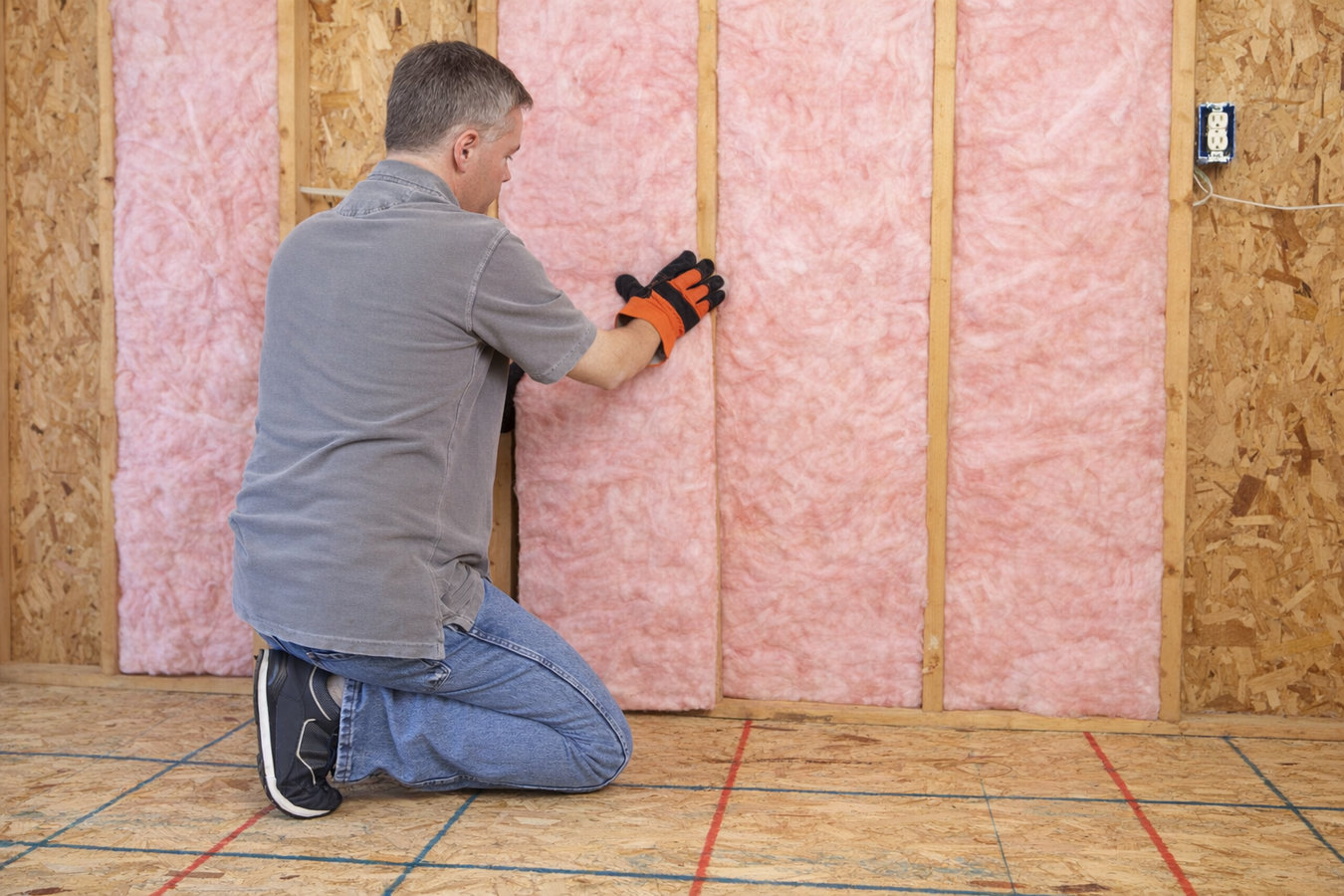
For homes undergoing renovation or new construction, we also install fiberglass batt insulation between open wall studs before drywall goes up. If your project involves blown-in insulation in multiple areas - walls, attic, or floor cavities - we can scope the full job in a single visit and complete it in one coordinated project, which reduces cost and disruption compared to scheduling each area separately.
Best for finished walls on existing homes. No drywall removal required, completed in a single day for most properties.
Standard choice for open wall cavities during new construction or renovation when studs are exposed.
Blown-in material packed at higher density to prevent settling over time. Suited to walls with unusual cavity dimensions.
For homeowners who want the full benefit of their insulation investment - sealing gaps and filling cavities in the same project.
Kennewick sits in the Columbia Basin, where summer temperatures routinely exceed 100 degrees and winter nights drop well below freezing - a swing of more than 100 degrees across the year. That range puts your walls under stress in both directions simultaneously: holding heat out in July and keeping warmth in during January cold snaps. Homes in this climate with poorly insulated walls are not just slightly less comfortable - they pay a steep energy penalty every single month of the year. The Columbia Basin's low humidity also means insulation does not face the moisture degradation common in wetter parts of Washington, which means properly installed wall insulation here holds its performance for a long time.
Beyond energy costs, wildfire smoke season adds another reason Kennewick homeowners value tight, well-insulated walls. When smoke settles over the Tri-Cities each summer, homes with air-sealed and insulated walls noticeably reduce how much outdoor particulate matter enters through gaps and cracks. We serve homeowners across Kennewick and the surrounding communities, including Richland and West Richland, where the same 1980s and 1990s housing stock faces the same thermal performance gaps.
Washington's energy code - administered through the Washington State Building Code Council - sets specific minimum R-values for wall insulation in this climate zone. We install to those standards on every job, not below them.
We respond within 1 business day. Tell us your home's approximate age, any rooms that feel uncomfortable, and whether you know if insulation work has ever been done. No obligation, no pressure.
We visit your home and check what is currently in your walls using a probe or thermal camera - without opening anything up. You will know exactly what your walls have and what we recommend before any work is discussed.
We follow up with a written estimate that specifies the method, coverage area, and expected outcome - not just a price. This estimate also notes whether rebates through Benton PUD or Pacific Power apply to your project.
The crew drills small access holes, blows insulation into each wall cavity, patches every hole, and provides a written coverage report when the job is done. Most single-story homes are completed in one day, and you can stay home throughout.
Free on-site assessment. Written estimate before any work begins. No obligation to move forward.
(509) 206-9343After installation, you receive a document showing where insulation was placed and at what depth. This is the proof you need for a utility rebate, a home sale disclosure, or simply your own records - and it is something many contractors do not provide.
Kennewick sits in Climate Zone 5B, which means exterior walls need a higher R-value than much of Washington State. We know what your walls are supposed to achieve in this climate and install to that standard - not the minimum that happens to be easiest.
We have worked on homes across Kennewick and the surrounding region. We know the housing stock - the stucco-clad 1990s subdivisions in Southridge, the older ranch homes near downtown, and everything in between. That local knowledge shapes how we approach each job.
Every wall insulation job is completed to Washington State energy code standards and documented in writing. That paper trail gives you a clear record of what was installed - useful if you ever sell your home or need to reference the work later.
Every wall insulation job we complete in Kennewick is backed by a written coverage report and an experienced crew that answers for the work. That combination - local knowledge, proper documentation, and accountability - is what you should expect from anyone insulating your home.
Air sealing closes the gaps that let conditioned air escape around your insulation, making wall insulation perform closer to its full rated value.
Learn moreBlown-in loose-fill is the primary method for insulating finished walls without tearing out drywall - a practical option for Kennewick's older housing stock.
Learn moreTriple-digit heat is coming. A free estimate now means you can have the work done before cooling season starts - and start seeing the savings on your first summer bill.